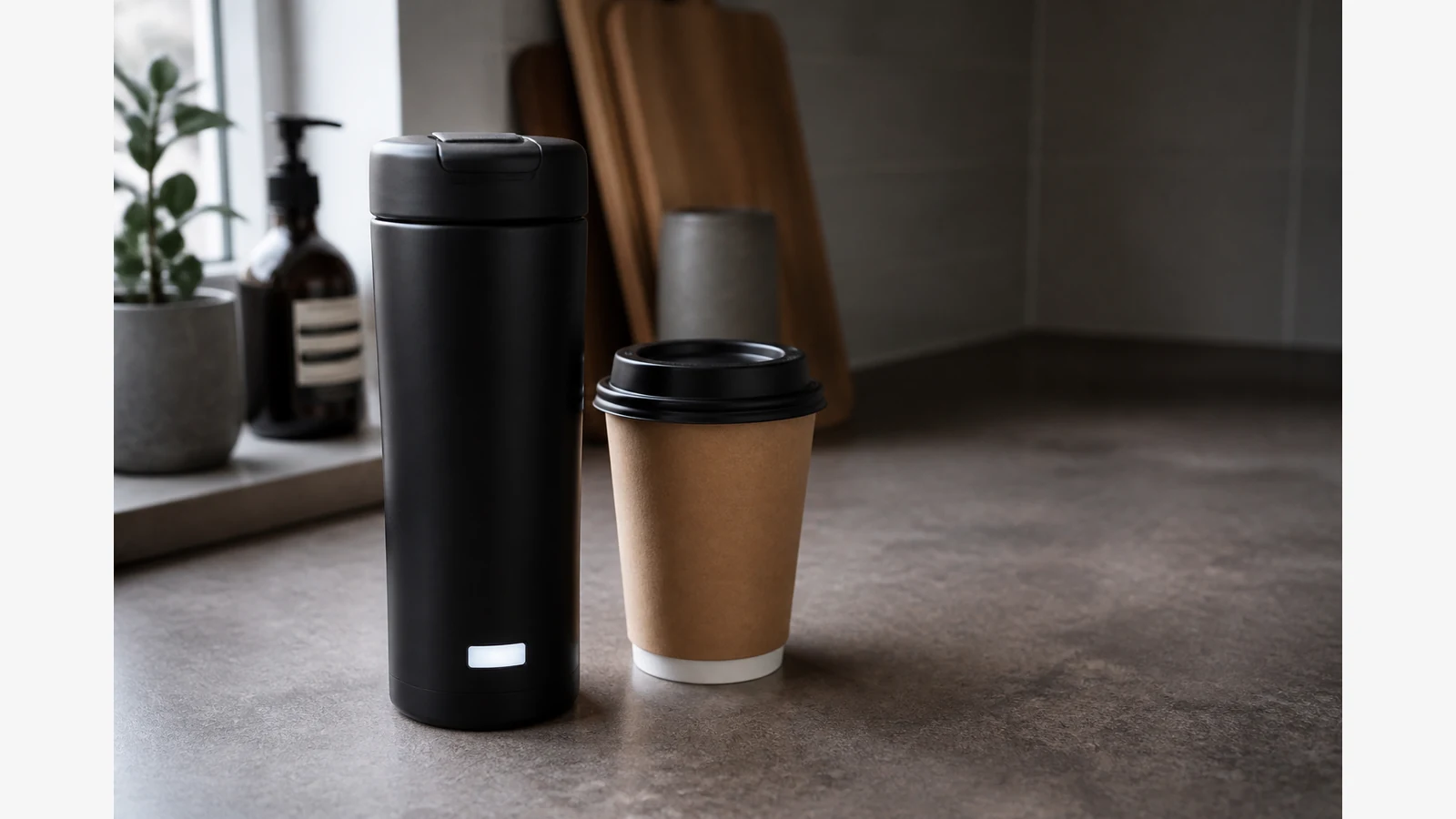
Self Heating Mug Uk
A self-heating mug actively holds a chosen sipping temperature with onboard power; a vacuum flask only slows cooling. For UK buyers, the useful question is not “which gadget is cleverest” but whether active heat matches your commute length, desk habits, and willingness to charge another device.
What a self-heating mug actually solves
Passive flasks excel at keeping a sealed drink hot for hours, then you open them when you are ready. Self-heating (temperature-control) mugs are built for stop-start sipping: train platforms, meeting rooms, and hybrid desks where the drink sits open and would otherwise drift lukewarm. UK buying guides emphasise control interface, power type, temperature precision, and realistic battery framing rather than marketing slogans — see the PickReviews UK heated travel mug buying criteria.
Independent category write-ups also flag the trade-offs: battery dependency, more careful cleaning than a simple flask, and premium pricing versus passive gear. The Barista Life pros and cons of self-heating travel mugs is a clear public summary of those limits.
UK buyer constraints worth deciding first
- Commute length — short Tube hops need different runtime expectations than long van days.
- Desk vs bag — docked desk mugs behave differently from sealed travel cups that spend time in a rucksack.
- Charging tolerance — if you already resent charging earbuds, another battery cup may frustrate you.
- Cleaning habit — most battery mugs are hand-wash devices; see our self-heating mug cleaning checklist.
Decision path: control, charge, capacity, care
- Control style — on-mug display or buttons versus app/Bluetooth degree control. If you want to skip pairing, read smart mug without an app.
- Charging method — proprietary dock versus cable (often USB-C). Hybrid routines usually prefer cable top-ups; see USB-C heated mug charging.
- Capacity — match roughly to your usual takeaway cup so you are not pouring leftovers into the sink.
- Care limits — treat electronics as hand-wash unless a specific manual says otherwise.
Buyer checklist
| Check | Why it matters in the UK |
|---|---|
| Battery expectations | Winter mornings and longer holds drain faster; treat published runtimes as guidance, not a guarantee for your drink. |
| Lid spill resistance | Bags, Tube crowds, and cup holders punish leaky lids. |
| Cup-holder fit | Car and van drivers need a base that actually seats. |
| Hand-wash reality | If you refuse hand-washing, a passive flask is usually the better tool. |
| Control without friction | Presets or an on-mug display beat fiddly setup for many commuters. |
For a deeper control-model comparison (presets vs precise control vs passive flasks), see the temperature-control mug decision guide. If you are still torn between active heat and a classic thermos, read self-heating mug vs thermos.
Who should not buy a self-heating mug
- Anyone who wants all-day heat with zero charging — a quality vacuum flask wins that job.
- Buyers who will only use dishwasher-only drinkware — battery cups usually need gentler care.
- People who finish every coffee in under 15 minutes — active heating adds little.
FAQ
How long do self-heating mugs typically run? Public guides discuss runtime as a buying criterion, but figures vary by drink volume, set temperature, ambient cold, and lid behaviour. Use manufacturer guidance for the specific model; do not treat round-up “about X hours” lines as lab results for every cup.
Is a warmer plate the same thing? No. Plate warmers heat from the base while the mug sits still; self-heating travel mugs carry power with the drink. Existing warmer-focused pages on this site cover plates separately — this guide stays on active travel cups.
If you specifically want an on-mug display travel option to evaluate next, review the Vortex smart travel mug product page.